
David Gewirtz
for ZDNet Government
| October 5, 2021
| Topic: Security
Shutterstock
There are VPN users who use VPNs just so they can safely surf the internet from a coffee shop, hotel, or airport. Before the COVID-19 pandemic, I mostly fell into that category. There are VPN users who, as mentioned, mostly use VPNs to spoof their location so they can watch blacked-out sports events or get Star Trek Discovery via Netflix instead of Paramount+.
There is some gray area here. While writers often purchase the items they review, many reviewers often receive the things they review for free. Companies want the attention of reviewers and their audiences. Companies can also withhold access, favoring those they know will speak positively or give their products glowing reviews. For example, I never get early access to Apple products because I’ve been critical of the company.
Done right, at least historically, marketing has been a mix of good advertising and good PR.
But the internet has changed that. It’s now possible to track what people read, what they click on, and what they buy. That technological capability gave rise to a new form of marketing: affiliate marketing. With affiliate marketing, when you click on a link that leads you to buy a product, the seller can see your entire track of interaction. This means the seller can know where you were when you clicked that link. If you click a link on ZDNet and then buy a product on Amazon, Amazon knows that the sale came from an article on ZDNet.
If you click on a link on ZDNet (or just about any other website) that has an affiliate code and then buy from Amazon, Amazon also pays a percentage of the sale back to the originating site. The idea is that the affiliate payment encourages sites to cover products.
And it works — very, very well. Sites get a lot of revenue (sometimes more than from advertising) from affiliate links. Many sites have full-time affiliate relationship managers who do deals with vendors for a percentage of the sales price — and then encourage editors to write about those products.
Done right; there’s no harm in this practice. But what does “done right” mean?
Done right means that editorial decisions drive coverage, not business decisions. For example, here at ZDNet, I choose what I want to cover. I get to say what I want to say about a product based on my professional experience. The commerce teams don’t have any input into my objective editorial opinion. If I write a more negative review because readers deserve to be aware of product limitations, no one tells me to hide those limitations.
In our case, once I write an article, the affiliate team reads those articles and will sometimes add affiliate links. I have no insight into what deals they have or how much they make. And here’s how that applies to VPNs.
I cover a lot of VPN services. I know, generally, that many of the VPN services have affiliate relationships with our commerce team. But I have zero visibility into those deals. As such, I choose the VPNs to cover and what I say entirely based on my editorial judgement. There’s no bias due to business relationships.
ZDNet does financially benefit from the fact that I cover VPNs, but not from any specific VPN.
But that’s not the case for all online sources of VPN reviews.
VPN companies who own VPN review sites
Last week, I discussed ExpressVPN’s week of rough news. One detail: ExpressVPN was bought by Kape Technologies for nearly a billion dollars. That sale price, alone, should show you how much these VPN service companies are raking in.
See also: Trust, but verify: An in-depth analysis of ExpressVPN’s terrible, horrible, no good, very bad week.
But it’s worse. A year earlier, Kape (which also owns VPN vendors Private Internet Access, CyberGhost, and ZenMate) bought a company called Webselenese. This company owns the VPN review site VPNMentor. So which VPNs does VPNMentor recommend as its best of 2021? It’s own: ExpressVPN in first place, CyberGhost in second, and Private Internet Access in third. That’s not suspicious at all (he says sarcastically):
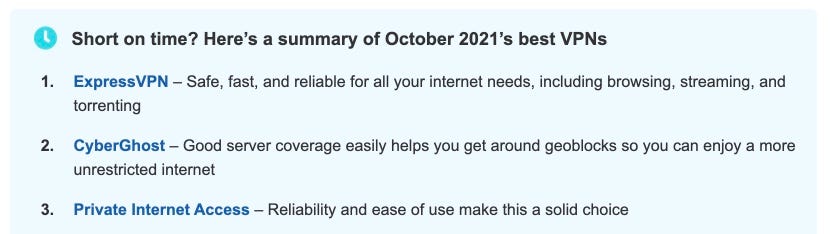
Source: VPNMentor.com
How valuable are reviews to VPN companies? Consider how much Kape spent on Webselenese. That amount: $149 million. If you’re going to spend $149 million to control the review conversation, there’s got to be a lot of money at play.
But Kape isn’t the only VPN company that owns its own reviews sites. Let’s spend a moment exploring J2 Global.
J2 Global launched in 1995 as the provider of the JFax faxing service. The internet was barely a thing back then, and faxing was big. Over the next decade and a half or so, J2 stayed pretty much in its lane, offering fax services under a variety of brands. Then, in 2012, it started a media acquisitions spree. In 2012, it bought publisher Ziff-Davis.
For the record, the ZD in ZDNet harkens back to the Ziff-Davis brand, but ZDNet was spun out as a separate company and hasn’t been affiliated with Ziff-Davis for more than 20 years. In some ways, in fact, we’re now direct competitors.
The J2 acquisition of Ziff-Davis bought the company a bunch of very familiar tech publications, including PCMag, Spiceworks, ExtremeTech, IGN, and Mashable. Then, in 2019, J2 scooped up VPN vendors SaferVPN, IPVanish, and StrongVPN.
Where VPNMentor is clearly biased in its coverage, I have to give it to PCMag.com. Of the ten best VPN services it lists on its “best of 2021” page, its parent company does not own one.

Source: PCMag.com
Even so, we’ve now identified that many of the top VPNs are owned by the same companies that own the top VPN review sites. Conclusion: If you’re putting your life on the line, you might not want to trust these sites for unbiased reviews.
What should you do?
Even unbiased reviews like those I produce aren’t enough to rely upon if you’re a VPN life-and-deather. I put in about a week of testing per VPN, and I test from here in central Oregon. I can’t travel all around the world and test how safe and secure a given VPN service is when used, for example, in the UAE instead of Oregon.
For those who haven’t been following along through all my VPN guides, VPN usage in the United Arab Emirates is illegal and could get you sent to jail or fined up to the UAE equivalent of $500,000.
While a professional reviewer might be able to provide a relatively comprehensive review of one VPN he or she lives with over the course of a few years, no reviewer is going to be able to spend months of time testing each and every one of an entire set of VPNs. It’s just not practical or possible. So no matter which reviews you read, the test results are going to be limited to what could be practically tested by the reviewer in question.
If your life is at stake, these tests are too limited. Period.
I’d recommend you dive much deeper into this tool you’re going to be depending on. First, read this excellent guide just recently put out by the NSA and CISA. A lot of it is designed for corporate networks, but the protocol discussion is first-rate.
Second, seek out others in your life-and-deather community. Folks who have dealt with the same kind of security challenges and risks will have a better experience than some other reviewer who only theoretically walks in your shoes. Read forums. Read user reviews. Read a lot.
And, third, get to know how VPNs work on a technical level. Here’s a Digital Ocean article that gets you started running your own VPN server. But don’t stop with just one article. If your life is dependent on this technology, learn.
Take courses on computer security. Learn everything you can on how data moves on the internet. Coursera, for example, offers free in-depth university-level classes. The only time you have to pay is if you want the credential. But if you’re more concerned about your personal security than your resume, you can learn a tremendous amount and not spend anything.
My bottom line for all of this is simple: There are ways you can learn enough to create a safer situation for yourself. Just quickly scanning product reviews tells you very little about the best way to stay alive and safe.
You can follow my day-to-day project updates on social media. Be sure to follow me on Twitter at @DavidGewirtz, on Facebook at Facebook.com/DavidGewirtz, on Instagram at Instagram.com/DavidGewirtz, and on YouTube at YouTube.com/DavidGewirtzTV.
ZDNet Recommends
The best VPN: Expert reviews of the best VPN services
What is a VPN and why do you need one? Everything you have to know
The fastest VPN: NordVPN, Hotspot Shield, and ExpressVPN compared
The best free VPN: Why they don’t exist
How to set up and use a VPN on Windows, Mac, iOS, or Android
NordVPN vs. ExpressVPN: Which VPN is best for you?
NordVPN vs. Surfshark: Which VPN is best for you?
ExpressVPN review: Is it worth the price?
Related Topics:
Security TV
Data Management
CXO
Data Centers
David Gewirtz
for ZDNet Government
| October 5, 2021
| Topic: Security